
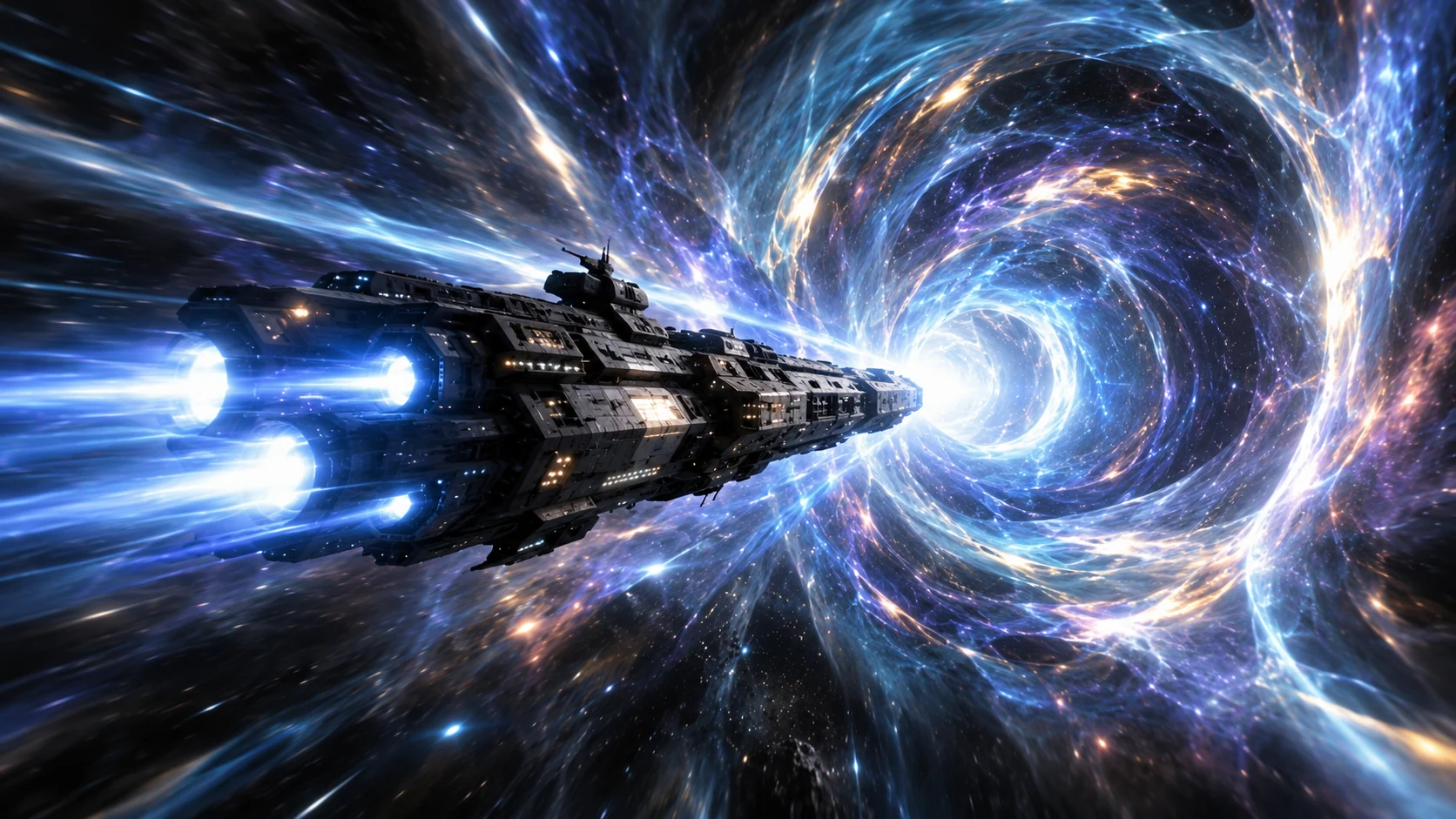
In No Refuge for the Lightning Touched (NRLT for short), humanity can cross the Andromeda Galaxy without spending generations aboard a ship. The technology that makes that possible begins with a real—and very strange—piece of physics: quantum entanglement.
The science doesn’t actually give us interstellar highways. That’s where the science fiction comes in.
What is Quantum Entanglement?
Quantum entanglement occurs when two particles become linked such that their properties remain correlated, even when the particles are separated by enormous distances. When one particle is measured, the results are correlated with measurements of the other in ways classical physics can’t explain. It’s the phenomenon Einstein famously described as “spooky action at a distance.”
Here’s where things get really interesting for a science-fiction writer. There is a theoretical idea called ER=EPR that proposes a relationship between quantum entanglement and wormholes. In very simplified terms, it suggests that two entangled particles might be thought of as connected by an incredibly tiny wormhole through spacetime.
Unfortunately for Gillian and crew, that doesn’t mean we’ve discovered interstellar travel. These theoretical wormholes aren’t giant tunnels waiting for someone to fly a spaceship through them. Making a traverse-able wormhole would require us to solve some rather substantial problems—including how to keep one open and stable. Otherwise, as soon as a ship entered the bridge, it would collapse around it, resulting in the ship—and everyone aboard—to die truly horrendous deaths.
So yeah, this is where my world departs, slightly, from reality.
In the Andromeda Galaxy, in which NRLT is set, humans have overcome this obstacle with Quantum Entanglement drives powered by exotic-matter reactors.
Building a Traversable Quantum Bridge.
The ship acts as a cosmic snowplow, projecting a forward cone of negative energy. The ship then rides its own wake, injecting negative energy and keeping the corridor open just long enough for the ship to pass through, after which, the bridge collapses safely behind it.

The Rules Matter.
This gives me some fun limitations to play with. Galaxy-spanning travel is possible without generational voyages, but it isn’t instantaneous. Ships inside a corridor have to maintain a precise speed to keep it stable. And because space isn’t flat, the corridors have to wind through the underlying quantum foam around gravity wells and density variations. So every bridge needs a different travel time. Some take hours. Some take days.
Those limitations are important to me. If technology can do anything the story needs whenever the story needs it, it stops feeling like technology and starts feeling like magic. Giving quantum bridges rules—and consequences for breaking them—lets them become part of the problems my characters have to solve rather than simply a way to get them from one planet to another.
That’s the fun of writing far-future science fiction: starting with something scientists are actually thinking about today, finding the point where current science says no, and asking what humanity would have to invent to turn that no into a yes.
In No Refuge for the Lightning Touched, one answer is a ship, an exotic-matter reactor, a carefully controlled quantum corridor—and a very strong incentive not to let that corridor collapse early.
Leave a Reply