
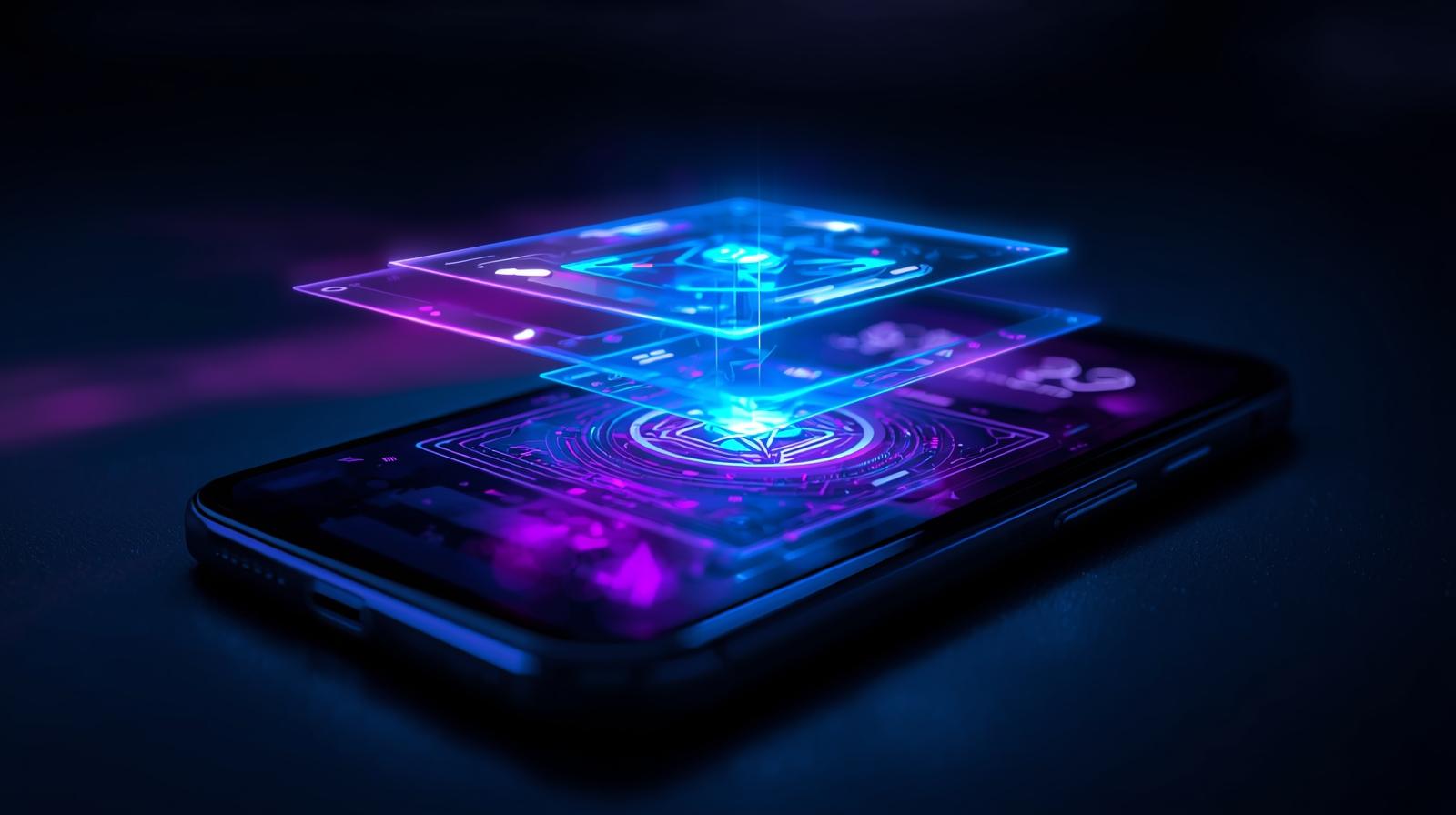
(Or are you just happy to see me?)
Advancements in optoelectronics could soon bring a holograph display to that smartphone in your pocket.
A Revolutionary Breakthrough
Awhile back, I told you about the first holoportation that projected a doctor in hologram form onto the International Space Station to provide concierge care to our intrepid astronauts. That technology required the receiver to wear a goggle-like device in order to see and interact with the hologram. This revolutionary idea to combine HMs with OLEDs will make those glasses unnecessary.
This idea is seriously cool! I am sure everyone has seen the standalone holographs created from spinning arms and lasers (if you haven’t, click here), and while those are cool, it is not very practical to carry around a mini-fan in your pocket just so you can turn your phone screen into a holograph. Well, physicists from the School of Physics and Astronomy at the University of St. Andrews have developed a new method that can turn screens as small as your phone into holographs all on their own.
Let’s Get Into It!
This cool new way to make a holograph is created by combining two existing types of tech, Holographic Metasurfaces (HMs) and Organic Light-Emitting Diodes (OLEDs).
You have probably heard of OLEDs before, but as a refresher, Organic Light-Emitting Diodes are the devices that create the colored pixels in your mobile phone. A normal OLED display, like the one on your phone, requires thousands of pixels to create a simple picture.
Holographic Metasurfaces are created by organizing tiny structures called meta-atoms into thin, flat arrays. And when I say thin, I am talking a thousandth of the width of a strand of human hair. These meta-atoms are designed to manipulate the properties of light.
The key to this new optoelectronic device is the combination of the HMs with the OLEDs. The OLED projects light through the HM. The meta-surface then causes the properties of the light to slightly modify. Due to these modifications, the physicists were able to exploit the principle of light interference (light waves create complicated patterns when interacting with each other) to create a pre-designed image on the other side of the HM. It literally shapes light!
FaceTime, Eat Your Heart Out!
This a breakthrough not only in capability, but also cost and access to the holograph technology. Up until now, there has been no reason to incorporate metamaterials into everyday applications. This development removes a major technological barrier, opening the way for miniaturized and highly integrated displays.
And because a complete image can be projected from a SINGLE OLED pixel, it also enables simpler, cheaper, and smaller displays.
Think about the applications! Your FaceTime call and online shopping are now in 3D. That virtual walkthrough of your future house is actually something you can walk through. It has military and Search and Rescue applications too, allowing users to view and inspect terrain without a 2D distortion.
This sort of technology has the potential to be incorporated in everything in a future or sci-fi world. I am most curious to see how it might change the movie/tv industry. Will we need TVs with horizontal displays on the bottom so we can see characters in 3D during that epic fight scene? Hmm, maybe I should wait on buying that new TV…and cell phone… You know, just in case.
Learn More Here:
May Imagination Reign! 🙂